Monday, May 3, 2010

Since I seem to have abandoned the "daily" thing, lets abandon the scatter plots as well.

So, I slowed down updating this, and haven't updated this in two weeks.

This is mostly because I feel I have exhausted a lot of what I wanted to talk about. Actually, I should at some point summarize what I have learned, but I don't have a lot more to say about most of what I was covering.

But, I did, on a lark, think of a question that can be used with another type of graph. And so, I present a non-scatterplot to you.

In the US election system, the president is chosen by electoral votes. The electoral system can greatly magnify a candidates success or failure. Also, electoral votes can be won by plurality, meaning a candidate can win the presidency in a landslide without actually winning any of the states by a majority. Clinton did this in 1992, only winning 9 electoral votes (Arkansas and DC) by majority, but getting 370 Electoral Votes.

So I decided to look at the history of how many Electoral Votes were won by over 60% of the vote. These show states that were won with what could be seen as a strong consensus. So from 1960 until 2008, here is the fate of both party's ability to truly capture states:
Much as with my scatterplots, the first lesson to be learned from this graph is unpredictability. The biggest lesson seems to be that holding on to Core Electoral Votes is very difficult. Even after the biggest landslides ('64, '72 and '84), the amount of core electoral votes drops. This also leads some credence to the belief that elections are more about candidates and circumstances than they are about the deep seated philosophical leanings of the electorate. Was Reagan's victory in 1984 a sign of a deep seated conservative bent in the US? According to this diagram, it would seem not, because just 4 years later, the amount of states showing a really strong commitment to support the Republican candidate shrunk down to just a few in strongholds. Of course, the same could be said of the movement from 1964 to 1968.

Another trend that actually shows up from popular political discourse in this is that some of the "Red State/Blue State" and "polarization" seems to have some evidence for it. In previous elections, one party might get a lot of Core Electoral Votes, or both parties might get none or close to none... but only since 2000 have both parties managed to have strongholds. So there is some truth to it: the current political situation is one where, regardless of candidate, Massachusetts will probably go over 60% for the Democrat, and Oklahoma will go over 60% for the Republican.

Of course, since the unexpected is expected, I bet 2012 will have some interesting changes to make to this chart.

Saturday, April 17, 2010

Education and the election by region: The Northeast

And we come to what would be our final region, the Northeast, or what would be our final region besides it seems that I didn't actually include the West when I posted earlier.
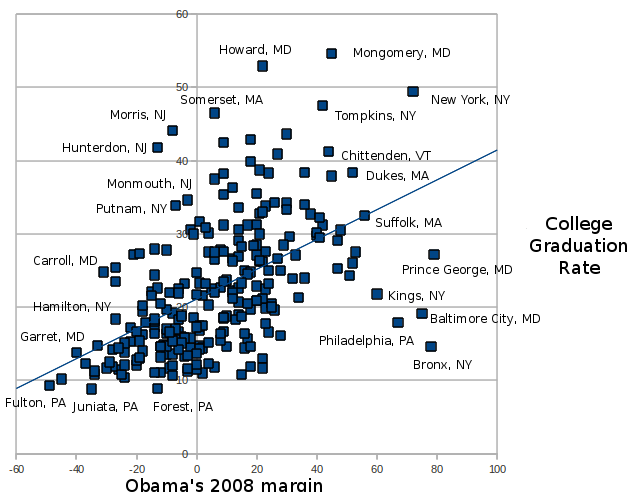
But the Northeast, (Maine, New Hampshire, Massachusetts, Vermont, Connecticut, Rhode Island, New York, New Jersey, Pennsylvania, Delaware and Maryland) even though it is declining in importance, is still one of the most important regions in the country, both electorally and otherwise. It has 114 electoral votes, and has a large manufacturing base, and some of the countries largest and most ethnically diverse cities. It is home to much of the country's educated elite, and is also very strongly and consistently Democratic. Other than a curveball plurality decision in New Hampshire, every state in this region has voted Democratic since 1992.
This area does have some conservative counties, but they are mostly in the rural areas of Appalachia. There is a smattering of educated counties that McCain carried, and most of them are in suburban New Jersey. Other than that, all of the counties over the 30% mark voted for Obama. However, there is a pretty good chance that a lot of this is due to race: as we can see from the lower right of this diagram, this area's ethnically diverse population was probably just as important to Obama's success as its college-educated population. The fact that there is a conservative middle class in New Jersey is a small chink in the armor of Democratic dominance in this region.

Thursday, April 15, 2010

Education and the election by region: The Midwest

The next region presented is the rolling heartland of America, the Midwest, which (for my purposes) consists of Minnesota, Wisconsin, Iowa, Missouri, Illinois, Indiana, Michigan and Ohio. This region is very diverse, having both some very large metropolises, and many rural areas. It has a manufacturing base and an agricultural base. This area also gave 85 of its 96 electoral votes to Obama, with losing Missouri by a few thousand votes.
As with many areas, we have a large bulk of counties in the lower left, mostly small, rural counties. There is also some counties extending out to the lower right, but not extending too far. In this region, there was many rural, white, low education counties that Obama won, although he won them by smaller margins. He won by 60-40 in rural Wisconsin and lost by 40-60 in rural Missouri. Other than that, the pattern seems to be to be tied between the 20 and 30 mark, and then for education to become a pretty strong factor in favor of Obama above the 30% mark, although there are a few wealthy suburban counties that voted for McCain.

Wednesday, April 14, 2010

Education and the election by region: Coastal South

Our next region is the Coastal South, which compromises Virginia, North Carolina, South Carolina, Georgia, and Florida. Once again, this is a somewhat artificial region, since I believe South Carolina and Georgia might have more in common with Alabama and Mississippi than they do with the metropolitan states of the coast. However, that is a running caveat, and since this entire thing has gone on for quite a while, lets look at what we have:
This area does have some high education counties, and actually quite a few of them, but they seem to be mostly located in Virginia (NoVA, to be precise), with a few in North Carolina. The high education suburbs that voted strongly for McCain are mostly in Georgia. Although Florida is included here, none of its counties are strong outliers, which may be significant. There is also not quite as many heavily minority, low-education counties as there were in the interior South.

Monday, April 12, 2010

Education and the election by region: Interior South

Due to a string of computer problems, I haven't been able to update people fully on the wonders of demographics and politics. But now I am able to do so, and I am going to move to the next region, the Interior South. I originally just did "The South", but that was too large of a region, so I decided to break it down into the Interior South and the Coastal South. The Interior South consists of Arkansas, Louisiana, Mississippi, Alabama, Tennessee, Kentucky and West Virginia. As always, this is a somewhat artificial group of states, but I think it makes sense in some ways.That being said, lets see what we have:
There are probably three major stereotypes that apply here: that compared to other regions, the Interior South is less educated, more conservative, and the vote is split more along racial lines than in any other region. And this plot shows that that is indeed the case.
There are only 11 counties with over 30% college graduates, and those counties voted for McCain over Obama 7-5. The most educated county in this region voted for McCain, and that seems to also be unique. Also, while the less-educated counties the Great Plains and western regions hovered around the 15% mark, here they seem to be clumped around the 10% mark.
Even the counties that did vote for Obama that have higher education rates seem to be the most African-American, and so the education here is mostly an artifact.
So:
In the interior south, race and not education is probably the defining mark of the electorate.

Saturday, April 3, 2010

Education and the election by region: Texas

After having done the great plains, I reach my 4th region: Texas.
Yes, Texas gets to be a region all by itself. Popular belief (especially amongst Texans) would have it that Texas is unique amongst the states, and it is not an unfounded belief. Because Texas has some very urban areas, some very rural areas, some very Hispanic areas, and has aspects of being both a Southern, a Great Plains, and a Western state, as well as the fact that it has lots and lots of counties, I decided to put it in a category of its own.
Texas has some of the patterns we know and (love), but has some patterns of its own. We have a lot of counties in the lower right that are strongly minority (most of which are Hispanic, but I think some African-American counties along the TX/LA border might be there too). We have a lot of rural, white, conservative counties in the lower left. We have some conservative suburban counties in the upper left. And we have our single "college town" county, Travis (home of Austin and the University of Texas) in the upper right.
One thing that is interesting is that while the conservative suburban counties in the upper left are slightly less conservative than the conservative rural counties in the lower left, they are still, compared to many other areas of the country, pretty conservative. In California, Orange County slipped through with a 2 point margin for McCain. Here, we have many counties over the 30 mark with big margins.
Second thing to notice: notice how close Dallas (Dallas), Bexar (San Antonio) and Harris (Houston) are to each other. These aren't the best educated counties in Texas, but they are three of the biggest. So it looks like the big urban areas are moving to the Democratic column, but I suspect that has to do with minority population: their better educated suburbs are still more conservative than them. Tarrant and Hays, which are both suburban counties, with good college rates, seem to be following the liberal pattern, though.
Also, notice in the bottom, there is a big hole in the middle. Low education counties in Texas are strongly conservative (if they are White) or strongly liberal (if they are Hispanic), but none of them seem to be contested.
I think the bottom line in Texas is that while the Black and Hispanic vote make it somewhat competitive, a state where the well-educated suburbs are still strongly conservative is fated to be conservative for a while longer.

Thursday, April 1, 2010

Education and the elections by region: The Great Plains

Since I have already done the mountain/Pacific Northwest states previously, I am skipping to the next region: the Great Plains. The Great Plains, which constitutes North Dakota, South Dakota, Nebraska, Kansas and Oklahoma, is the smallest region in terms of population that I will be looking at. But I feel that it is indeed a unique region, because unlike the Western States, which tend to have geographically larger counties, the counties in this area tend to be smaller, and have no barriers between them. Thus, there are much fewer places where counties have distinctive demographies. This is also the case in the Midwest, but unlike in the Midwest, the Great Plains has fewer enclaves that are either ethnically diverse or home to manufacturing. Thus, it makes sense to treat the Great Plains as a region.
The Great Plains region is also, electorally speaking, not very diverse or interesting.
As with other regions, the lower right corner is composed of ethnic communities, which in this region are all Native American. Otherwise, there is a big clump of counties between -80 and 0, and between 10 and 20, and then a smattering of counties running upwards, and ever so slightly to the right, above the 20 mark. However, there is on the face of it very little tie between college education and voting patterns. However, this is another place where the population difference of counties makes a big difference. Douglas County, Nebraska, has 1/4th of the population of Nebraska, making it just as important for Nebraska as Los Angeles County is for California. Douglas County, Nebraska also contains an entire congressional district, and under Nebraska's almost-unique system of giving electoral votes, was Obama's sole electoral vote in this region.

From the information here, I can't see if there is a trend, and how much of a trend there is, between education and voting patterns in the Great Plains.